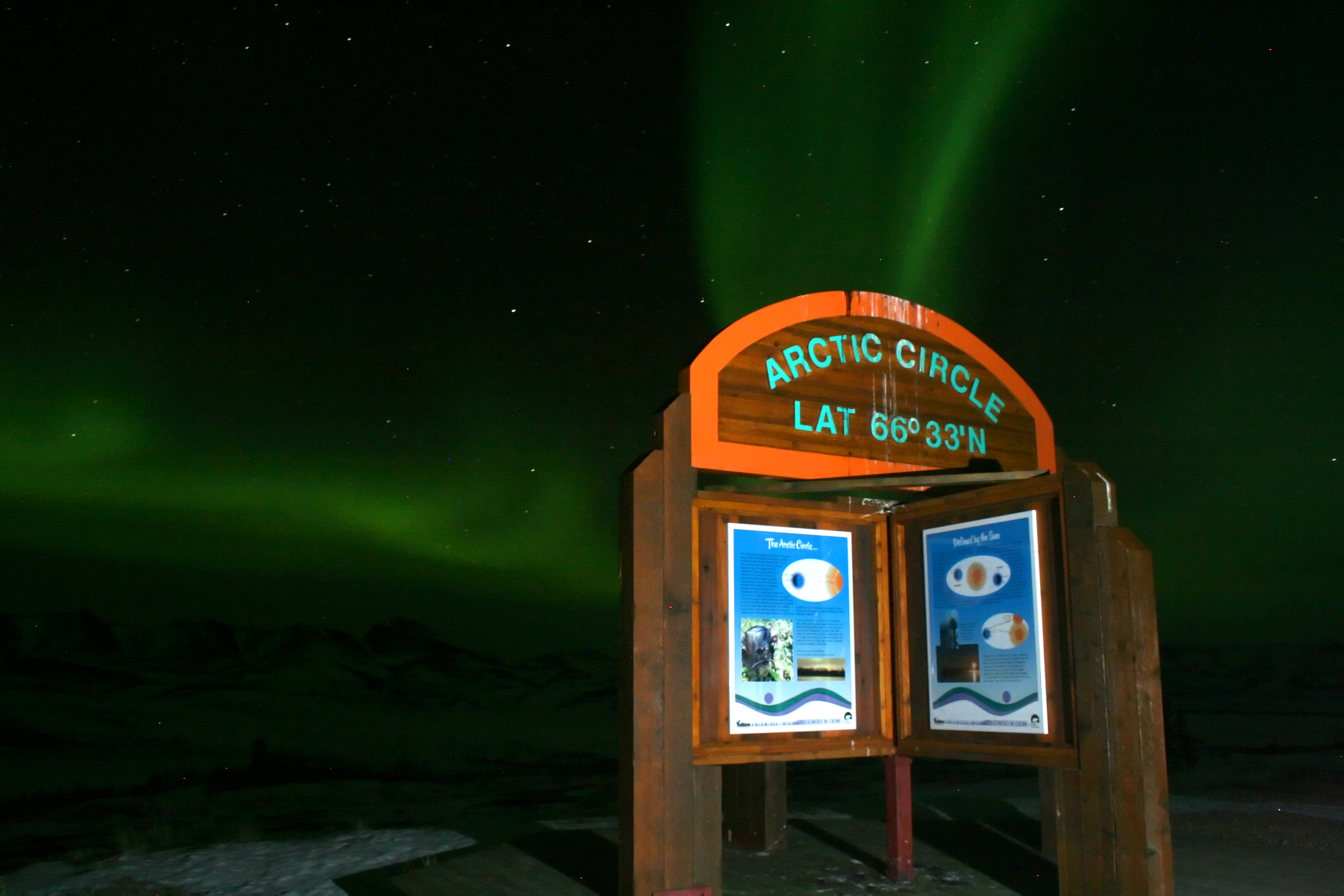
The aurora borealis appears throughout northern Canada, but the Northwest Territories occupies a particular position for those who travel specifically to see it. Yellowknife, the territorial capital, sits directly beneath what aurora scientists refer to as the auroral oval — a ring-shaped zone of maximum geomagnetic activity that encircles the magnetic north pole. This geographic alignment, combined with the city’s relatively low annual precipitation and more than 240 clear nights per year, gives it a statistically high probability of aurora activity on clear nights between late August and mid-April.
The Science Behind the Aurora
The aurora forms when charged particles ejected by the sun interact with Earth’s magnetic field and are directed toward the polar regions. As these particles enter the upper atmosphere, they collide with oxygen and nitrogen molecules, transferring energy that is released as visible light. The characteristic green of most auroras comes from oxygen atoms at altitudes around 100 kilometres. Red tones appear at higher altitudes where oxygen is less dense. Blue and purple hues result from nitrogen interactions.
Aurora activity correlates with the sun’s approximately eleven-year cycle of activity. During and around solar maximum — when sunspot activity peaks — geomagnetic events are more frequent and more intense. Aurora forecasting draws on data from NASA’s Advanced Composition Explorer satellite and NOAA’s Space Weather Prediction Center, which publish Kp-index forecasts. The Kp index is a scale from 0 to 9 measuring geomagnetic disturbance; at Yellowknife’s latitude, even moderate Kp values of 2 or 3 can produce visible aurora activity.
When to Visit
The practical viewing season in the NWT runs from late August through early April. This window balances two requirements: sufficient darkness and a reasonable probability of clear skies. In June and July, the NWT experiences near-continuous daylight at its northern latitudes, making aurora viewing impossible regardless of geomagnetic activity.
March is frequently cited by aurora tourism operators in Yellowknife as combining strong darkness hours with the improving daylight and somewhat milder temperatures of spring. January and February offer the longest nights but also the coldest conditions, with temperatures regularly falling below −30°C and occasional cold snaps to −45°C. Both months are viable for aurora viewing, but outdoor exposure time needs to be managed carefully.
Yellowknife’s Position
Yellowknife sits at approximately 62°N, just below the 60th parallel boundary that separates it from the provinces. Its position directly under the auroral oval means that on a high-activity night, the aurora does not appear as a distant band on the northern horizon, as it does from more southerly latitudes. Observers in Yellowknife frequently see the aurora directly overhead and across the full sky.
The city is surrounded by boreal forest and the interconnected lake system of the Canadian Shield, which provides dark viewing areas within short driving distance of the downtown core. Frame Lake, located within the city limits, is one accessible location. The Old Airport Road area south of the city, and a network of gravel roads north of Highway 3, offer lower light pollution.
Aurora Tourism Infrastructure
Aurora-focused tourism has been part of the NWT economy since the early 1990s. Japanese visitors have historically made up a significant portion of Yellowknife’s aurora tourism market, driven in part by cultural associations with the northern lights and the city’s direct flight connections from Japanese airports that operated for a period during peak seasons.
Several lodges and operators outside Yellowknife run heated viewing structures positioned away from city light pollution, with roof openings, outdoor hot tubs, or elevated decks oriented toward open sky. Some operations provide guided night viewing with transport, aurora probability briefings, and equipment recommendations. The level of infrastructure around aurora tourism in Yellowknife exceeds most comparable northern destinations.
Practical Viewing Conditions
Temperatures in Yellowknife during peak aurora months range from −20°C to −40°C. Standing still outdoors for extended periods in these conditions requires preparation that goes beyond standard winter clothing. A thermal base layer, heavy insulating mid-layer, wind-resistant outer shell, insulated boots rated to −40°C, and hand warmers are standard for aurora watchers spending hours outside.
Photographic equipment responds poorly to extreme cold. Battery capacity drops sharply below −20°C, often to a fraction of normal rated life. Photographers typically carry spare batteries inside inner pockets, close to the body, swapping them out as primary batteries deplete. Lens condensation occurs when moving equipment from cold outdoor air into a warm interior; allowing equipment to acclimatize slowly in an intermediate space helps prevent fogging that can affect glass surfaces.
Aurora photography requires a camera capable of manual settings — wide aperture lenses of f/2.8 or wider, ISO values in the 800–3200 range depending on activity intensity, and exposures of 5 to 15 seconds on a stable tripod. The aurora moves. Longer exposures that might resolve faint subjects will blur active aurora curtains into smears. Reading conditions and adjusting exposure accordingly is a skill that develops over multiple nights.
Beyond Yellowknife
Other NWT communities also offer aurora viewing with less developed tourism infrastructure. Inuvik, located near the Mackenzie Delta at approximately 68°N, sits well inside the Arctic Circle. Its longer polar nights in midwinter provide extended viewing windows, and its position farther north means even moderate geomagnetic events can produce strong aurora displays.
The Dempster Highway, which connects Inuvik to Dawson City in the Yukon, is traversable in winter and passes through some of the least light-polluted terrain in North America. Travellers on the highway in winter conditions encounter auroras against backgrounds of open tundra and spruce forest with no artificial light sources for hundreds of kilometres.
Fort Smith, at the southern end of the NWT, serves as the gateway to Wood Buffalo National Park — the largest national park in Canada and a designated Dark Sky Preserve recognized by the Royal Astronomical Society of Canada. The park’s remote location and enforced lighting restrictions make it one of the most consistent locations in the country for aurora and deep-sky viewing.
Reading Aurora Forecasts
Regular aurora watchers in the NWT develop a routine of monitoring conditions. The Kp index, available from NOAA’s Space Weather Prediction Center, provides short-range forecasts of geomagnetic activity. Free applications including SpaceWeatherLive and My Aurora Forecast aggregate this data and display localized probability estimates based on current location and the 27-day solar rotation cycle.
Cloud cover remains the primary uncontrollable variable. A Kp9 event — the most intense category of geomagnetic storm — on an overcast night produces no visible aurora. Weather forecasting for the Yellowknife area is provided by Environment and Climate Change Canada, and experienced aurora watchers cross-reference geomagnetic activity forecasts with cloud cover predictions before committing to a night out.
The uncertainty is part of what draws people back. Unlike an attraction with set hours and guaranteed outcomes, the aurora operates on its own schedule. That unpredictability, within a territory that has done considerable work to make it accessible, is what defines the experience for most of the people who travel north specifically to see it.

